The $2 Trillion Gap
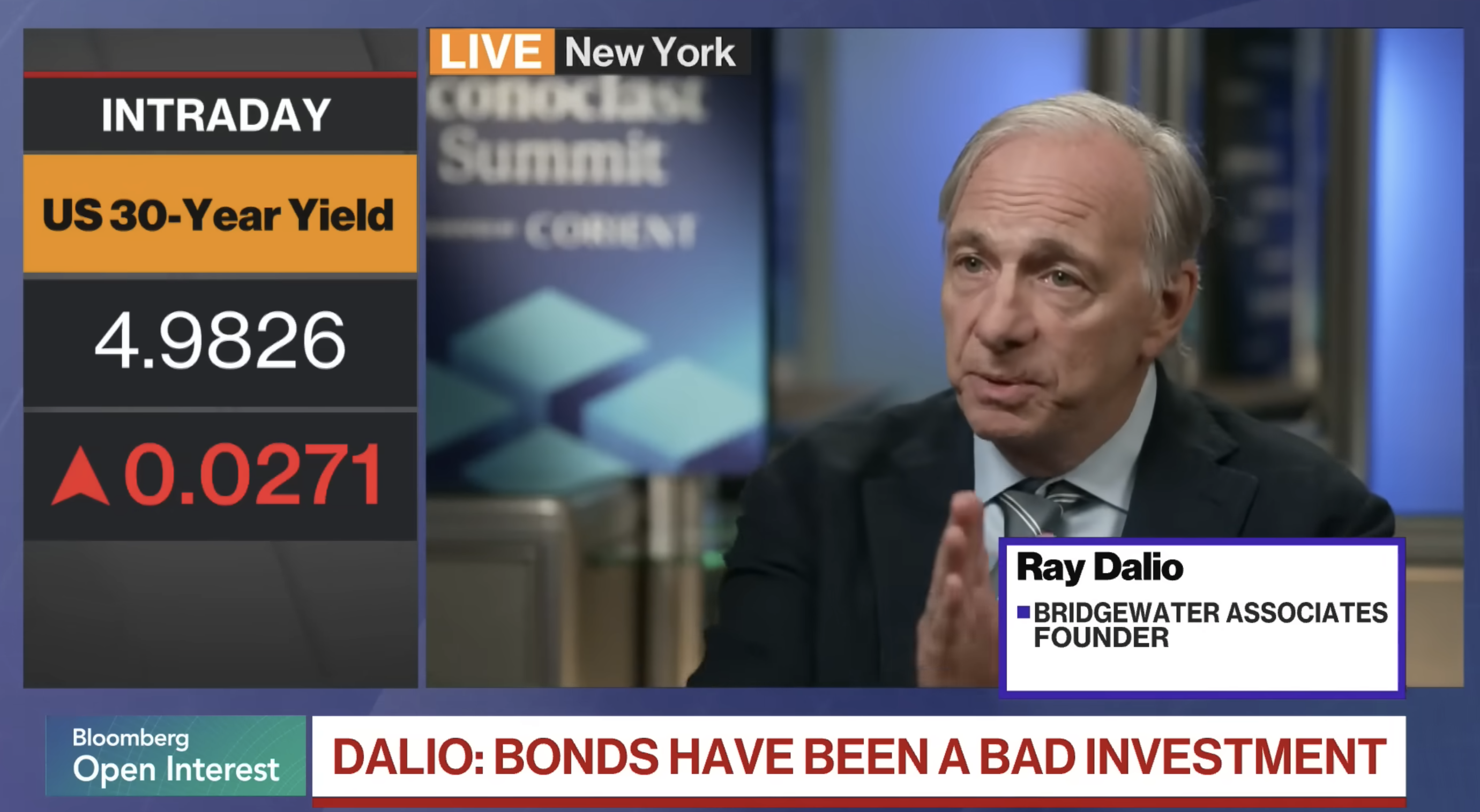
The arithmetic is straightforward; the implications are not. The federal government spends roughly $7 trillion a year and collects about $5 trillion in revenue. The $2 trillion shortfall has to be borrowed and reborrowed, indefinitely. Dalio frames this less as a budgeting problem and more as a physiological one — debt accumulates the way arterial plaque does, silently and non-linearly, until the restriction becomes acute. The political tendency to treat the deficit as an abstract concern, rather than a compounding structural liability, is itself part of the danger. Because a full fiscal collapse has not happened in modern American memory, the risk registers as theoretical rather than imminent.
What the Bond Market Already Knows
The supply of new Treasury debt is outpacing natural demand, and the market is responding predictably — by pricing in more risk. Long-term interest rates rise relative to short-term rates in what bond traders call a bear steepening of the yield curve. Higher long yields make bonds more attractive versus equities on a pure return basis, pulling capital out of stocks and into hard assets like gold. Dalio's point about Federal Reserve independence cuts sharply here: no policy declaration can substitute for genuine market demand. If real returns on US sovereign debt are not high enough, global investors stop buying — and no amount of institutional credibility changes that calculus.
The 1930s Toolkit
When debt service costs grow large enough to threaten the entire federal budget, the historical record shows governments reaching for a predictable set of tools. Dalio catalogued them: quantitative easing to suppress long-term yields below their natural clearing rate, higher taxes and elevated inflation to maximise nominal revenue, and in more extreme historical instances, capital controls and restrictions on private gold ownership to prevent wealth from leaving the system entirely. He draws the 1930s comparison deliberately. The structural trap is binary — let markets clear freely and yields become catastrophic; manipulate them to survive and the currency gradually loses its store-of-value function. In either case, fiat debt instruments become a poor long-term vehicle for preserving wealth.
Financial Overextension and the Taiwan Scenario
America's external geopolitical position is only as strong as its balance sheet. Dalio compared the current US situation to Britain in 1956, when financial overextension left the country unable to sustain control of the Suez Canal — a turning point that permanently reclassified Britain as a secondary power. The modern equivalents are the Strait of Hormuz for energy and the Taiwan Strait for semiconductors. A week-long disruption to Taiwan's chip exports, Dalio argued, would be enough to trigger a cascading collapse across global equity markets and derail the AI infrastructure buildout almost immediately. He added that international leaders he spoke with during a recent month in Asia noted openly that the American public lacks the tolerance for the economic costs a great-power conflict would require.
Paper Wealth and the AI Bubble
The current AI capital boom illustrates a recurring macroeconomic illusion: the confusion of wealth with money. When a startup raises $50 million at a $1 billion implied valuation, the financial system records a billion dollars of net worth — even though only $50 million of actual capital changed hands. Dalio's proprietary bubble metrics show market concentration now approaching levels last seen before the dot-com crash, the 1929 melt-up, and the late-1980s Japanese asset bubble. Alphabet recently launched a combined equity and debt offering targeting $85 billion, a figure that contextualises the sheer scale of spending commitments being made. The underlying technology is real and will deliver genuine productivity gains — that much Dalio concedes. The pricing of it is another matter. The mechanism that eventually forces the reckoning is always the same: a wealth tax, a sharp liquidity tightening, any event that forces the conversion of paper wealth back into money. History suggests the reset, when it comes, tends to be rapid.