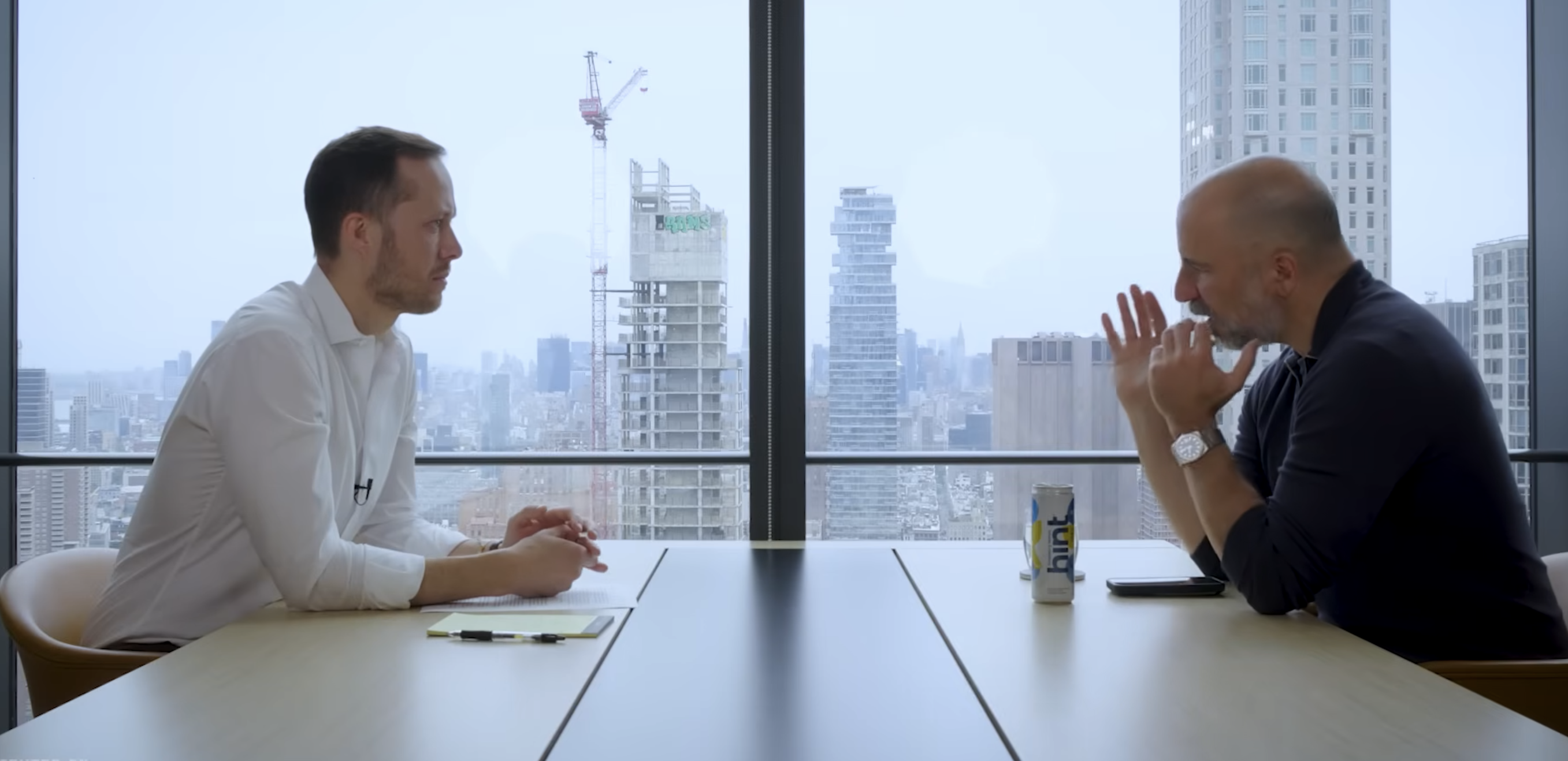
Turning Down the Job, Then Taking It
Khosrowshahi's initial response to Uber's recruitment was an explicit refusal. The company had a volatile public profile, mounting legal exposure, and no functioning chief executive — after Travis Kalanick's departure, the enterprise was being managed by an unstructured committee rather than a unified leader. What changed his mind was a conversation with Spotify's Daniel Ek, who reframed the question: "Since when is life about happiness? It's about impact." Khosrowshahi arrived to find a board paralysed by internal proxy wars over control rather than focused on what the company should become. His early moves were deliberate and structural — appointing Ron Sugar as independent Chairman to stabilise board factions, elevating Andrew Macdonald to President and COO to preserve institutional knowledge, and hiring Tony West as Chief Legal Officer to rebuild the regulatory relationships the previous era had systematically destroyed.
Supply-First Marketplaces
One of the sharper frameworks Khosrowshahi offers is the distinction between demand-first and supply-first marketplace architectures. Expedia, where he spent 13 years, is demand-first: aggregate digital consumer intent and force hotel and airline inventory to respond. Uber is the inverse. In physical asset-light marketplaces, growth is supply-constrained — onboard enough local drivers, merchants, and couriers, and consumer demand materialises automatically around them. This is why Uber's geographic expansion strategy focuses on the "next 50" and "next 200" municipalities within a country rather than extracting more from saturated tier-one cities. Sparse markets lack the dense organic liquidity of major metros, which means expansion requires boots-on-the-ground supply recruitment before any digital flywheel can turn. Uber's deep learning models — scaled up to 10,000 times larger than historical equivalents — now predict a user's final destination 75% of the time on app open, compressing the booking journey toward a single tap.
Uber as the AV Aggregation Layer
Khosrowshahi's thesis on autonomous vehicles is not that Uber will build the best self-driving system. It's that the AV market will fragment across multiple competing developers — mirroring the LLM landscape — and the long-term winner will be the platform that controls marketplace liquidity, commercialisation infrastructure, and asset utilisation. Uber currently has over 30 active AV partnerships including Waymo, Nvidia, Waabi, WeRide, and Pony.ai, alongside a $1 billion vehicle financing facility with Santander for EV and AV fleets. The utilisation data supports the thesis: AV units deployed through Uber's dispatch network realise a 30%-plus efficiency premium in daily trips and revenue per vehicle compared to non-network autonomous operations. When Waymo tries to bypass aggregators with direct-to-consumer networks, Khosrowshahi points to travel industry precedent — even premium hotel chains with strong direct loyalty programmes must offload excess capacity to third-party platforms to push occupancy past the 70% baseline needed to cover capital costs.
The Political Threat Is Bigger Than the Engineering Problem
Khosrowshahi is direct about where full-scale AV deployment is most likely to fail, and it isn't a technical problem. Early empirical data from Uber's commercial AV operations in Austin and Atlanta shows that introducing autonomous fleets to a market actually increases human driver sign-ups and earnings by expanding aggregate local trip demand — the job displacement story is more complicated than the headline suggests. The existential risk, in his view, is that deployment outpaces the psychological comfort level of local regulators and communities. The average citizen links autonomous vehicles to grid strain, employment anxiety, and friction with emergency responders — not to optimised route efficiency. If the industry moves faster than public trust allows, it risks a political shutdown that no amount of engineering progress can reverse.
Finding the Troublemakers
Khosrowshahi's management philosophy runs directly against the grain of large corporate structures, which are designed to maximise compliance and smooth out non-conformity. To stress-test his own understanding of the platform, he bought an e-bike and delivered food orders in San Francisco; he drove passengers in his personal Tesla to experience driver-side UI friction firsthand. He notes that a standard P95 system bug hits a casual consumer roughly once a month, but affects an active driver multiple times per week given their 6-to-10-hour daily app exposure — meaning Uber's most important quality signal comes from the people most filtered out of standard executive reporting. His approach to counter this is deliberate: break up structured calendar time, seek out random interactions across lower tiers of the organisation, and protect the internal "troublemakers" — the dissenting voices that large enterprises naturally push away but that carry the clearest early signal that something needs to change.