Why SpaceX Is Finally Going Public
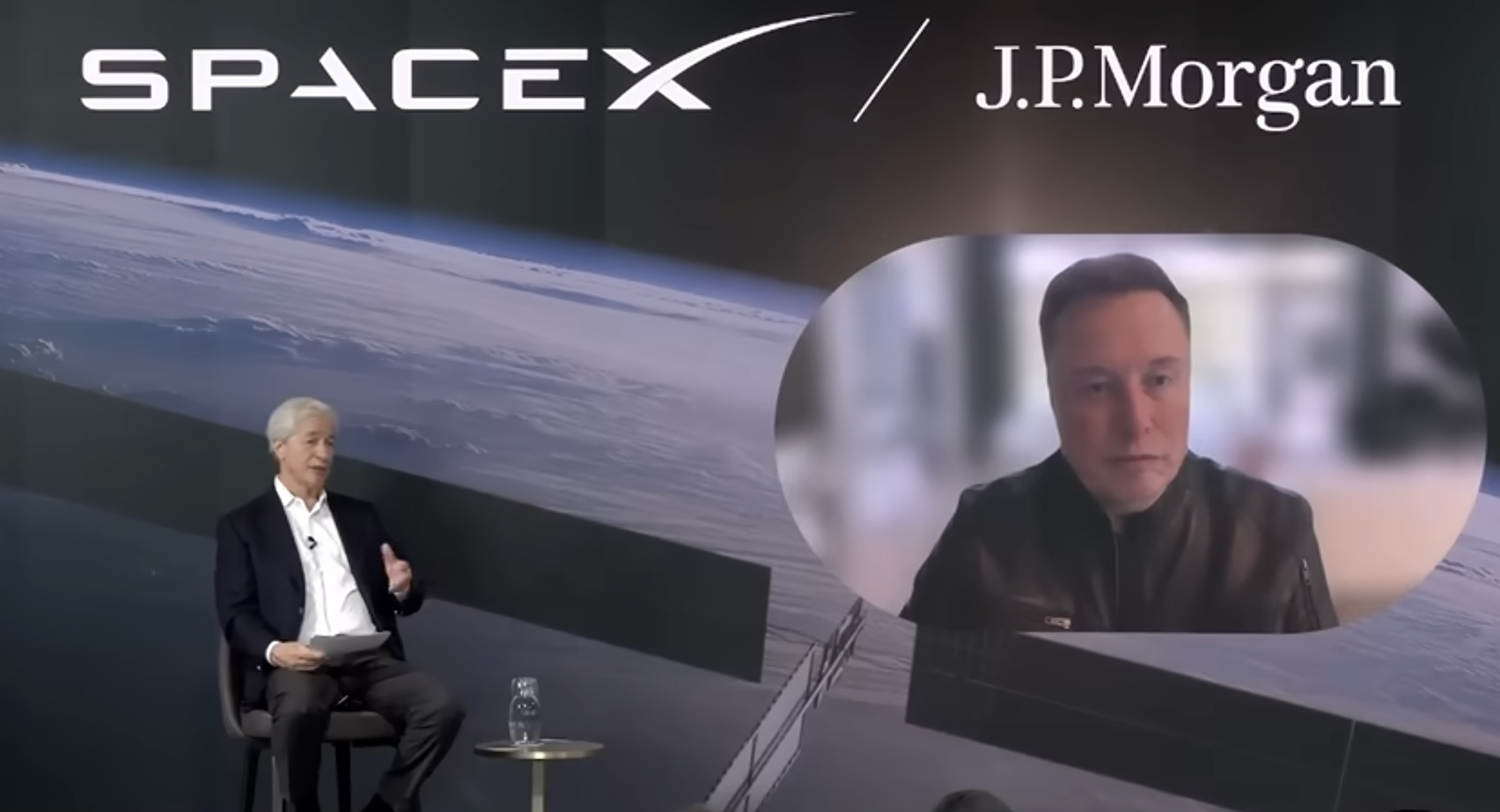
SpaceX has been cash-flow positive since approximately 2014–2015. Historical private rounds were largely secondary liquidity events — stock buybacks for employees and early investors — rather than primary fundraising. What has changed is the scale of the next phase. Deploying a megaconstellation exceeding 100,000 satellites, building space-based AI compute infrastructure, and constructing a domestic chip fabrication facility requires a magnitude of capital that self-funding cannot sustain at the required velocity. The transition to public markets is a function of capital intensity, not operational necessity. Musk noted the distinction sharply: human peak communication bandwidth runs at a few hundred bits per second; the data appetite of AI and robotic systems requires a minimum of one terabit per second per node — an entirely different order of infrastructure.
The Energy Ceiling and the Space Escape
Doubling US electricity generation — already running at around 500 gigawatts — would require building twice as many terrestrial power plants. Musk treats this as a socio-political impossibility, not an engineering challenge: the permitting timelines, community opposition, and grid infrastructure required make meaningful near-term scaling effectively blocked. Space-based solar arrays operate outside every one of those constraints. In orbit, a solar array captures energy continuously without atmospheric loss, seasonal variation, or cloud cover. Musk's framing is deliberately scalar: the Sun outputs enough energy that even deploying arrays capturing a one-millionth fraction of its total output would satisfy the energy requirements of a civilisation orders of magnitude larger than today's. The Moon functions as the industrial staging point — with one-sixth of Earth's gravity and no atmosphere, it enables electromagnetic mass drivers rather than chemical rockets to launch heavy data-centre components into deep-space orbits, scaling compute generation from roughly one terawatt per year under terrestrial launch constraints to over 1,000 terawatts annually using in-situ lunar manufacturing.
Starlink V3 and the Death of Undersea Cable
Musk described the Starlink Version 3 satellite as a non-linear performance leap over its predecessor: a 10x to 20x capability increase, 100x total system bandwidth improvement, and 50% latency reduction achieved by operating at roughly half the orbital altitude of V2. The satellite is the size of a city bus — seven metres wide — which physically saturates Starship's 30-foot payload bay and makes it impossible to launch on any other operational rocket on Earth. Three custom ASICs were developed internally to drive the system, alongside larger phased-array antennas, inter-satellite laser cross-links, and W-band and E-band spectrum architectures. V3's performance profile, Musk argued, puts it structurally ahead of undersea fibre-optic networks on latency for intercontinental routes. Starship V4, targeting over 200 tons to orbit per mission on an hourly launch cadence, is designed to clear the manufacturing backlog.
The Tera Fab: America's Memory Manufacturing Gap
The most pointed domestic policy argument Musk made concerns memory. The current volume of high-density computer memory fabricated inside the United States is zero. Micron's Idaho facility won't reach volume production until 2028; subsequent New York facilities are delayed until 2029 and 2030. Even if every announced facility executes on schedule, cumulative output will remain structurally incapable of meeting the demand curve generated by next-generation compute architectures. SpaceX is responding by initiating construction of what Musk calls the "Tera Fab" in New York — an internal facility to manufacture custom AI logic chips, high-bandwidth memory, and advanced multi-chip packaging stacks. The underlying logic is the same one that drove Tesla's vertical integration and Starship's in-house engine programme: when an external supply chain represents a fatal bottleneck, absorb it.
Hardware Agnosticism as Infrastructure Strategy
The orbital compute layer SpaceX is building is deliberately hardware-agnostic. Onboard rack architectures are engineered to accept Nvidia GPUs, Google TPUs, Amazon Trainium accelerators, and SpaceX's own proprietary silicon interchangeably. The software stack is similarly decoupled, allowing third-party developers to execute arbitrary neural network weights on orbit. Musk's reasoning is strategic: an open infrastructure utility captures more commercial value than a proprietary ecosystem, and the thermodynamic constraints of space — where heat can only be dissipated radiatively in vacuum — are severe enough without adding silicon ecosystem lock-in on top of them. The satellite bus is stripped to its core: high-efficiency solar arrays, heavy-duty thermal radiators, and basic housekeeping avionics, with data routed through inter-satellite laser links back into the Starlink constellation and down to ground stations via frequencies that penetrate cloud cover.