Episode map · Brighter with Herbert
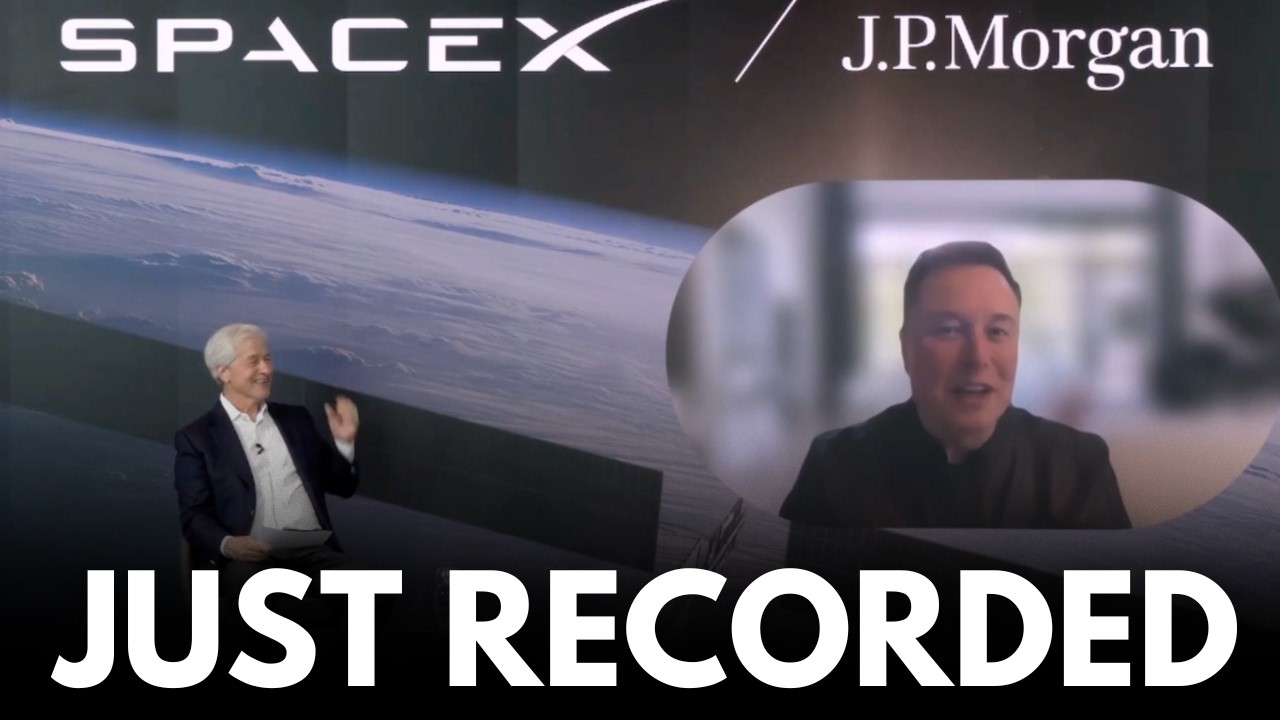
JUST RECORDED: Elon Musk Interviewed by JP Morgan's Jamie Dimon
Elon Musk speaks with Jamie Dimon at JP Morgan's headquarters to discuss SpaceX's transition to a public company to fund the deployment of over 100,000 communication satellites. Musk details plans for fully reusable Starship rockets, lunar bases, and the construction of space-based AI data centers powered by orbital solar energy. He also outlines the necessity of building domestic "Terafabs" to supply the chips required for advanced AI computing.
Top 5 for this episode
If you only watch five moments
Ranked by what matters most in this conversation — start anywhere, no scrubbing required.
Musk proposes using the moon's low gravity and lack of atmosphere to shoot AI data centers into deep space using electromagnetic railguns.
By achieving full reusability and using cheap liquid oxygen and methane, Starship aims to make space cargo transport cheaper than transoceanic flights.
Musk reveals plans to build AI data centers in space, where solar energy capture can be scaled up dramatically without facing local community pushback over terrestrial power plants.
Musk points out that America currently has zero high-volume computer memory fabs and argues for the creation of new Terafabs to meet upcoming AI compute demands.
SpaceX plans to operate a flexible AI satellite platform that allows users to run hardware from competitors like Nvidia, Google, and Amazon in orbit.
Full episode map
Every section, in order
Jump straight to the part you want — every section plays right here, from that exact moment.
Elon Musk is welcomed to JP Morgan's 51st-floor headquarters by his mother Maye and CEO Jamie Dimon.
Musk explains that SpaceX is entering a significant capital growth phase to launch over 100,000 communication satellites.
Musk outlines plans to orbit satellites with 100 times more bandwidth and build space-based AI data centers to bypass the difficulties of building terrestrial power plants.
The lack of atmosphere and low gravity on the moon would allow electromagnetic mass drivers to launch AI data centers into deep space.
Starship uses inexpensive liquid oxygen and methane propellants to become the first fully reusable orbital rocket.
The upcoming Starlink V3 satellites are the size of small buses and feature large phased array antennas and advanced laser communication systems.
Space-based AI data centers will use solar power and radiators to connect to the ground via cloud-penetrating laser links.
Musk advocates for building high-volume Terafabs because current and planned US semiconductor facilities cannot meet the anticipated demand for memory and logic chips.
The planned AI satellites will be hardware-agnostic, permitting the installation of GPUs and TPUs from companies like Nvidia, Google, and Amazon.
Musk states that retaining top talent requires a strong mission to explore space and a focus on hiring intellectually capable people who also have a good heart.